
In Case You’re Interested in a Few More Highlights
- Route 66 is known as the Mother Road: During the dust bowl and Great Depression of the 1930’s, it was the path for those desperate to migrate west from the dry, dusty central plains to where they could find work and a better life in California.
- The longest uninterrupted stretch is located in AZ about 155 miles from Ashfork to Oatman that includes a nausea-inducing eight-mile stretch of 191 hairpin turns.
- Previously a ghost town, Oatman reinvented itself into an entertainment destination with a wild West show, souvenir/memorabilia shops, eating places, and a host of friendly burros that can be handfed.
- Amboy is a ghost town working on revival, with a fuel/convenience store and restoration of a cafe and motel.
- The long drive from Oatman to Barstow crosses the Mojave Desert: no cell service, no fueling stations, no rest stops, and no humanity.

- Calico, California, a true ghost town that Walther Knott (founder of Knott’s Berry Farm) revitalized in the 1950’s by purchasing a late 1800’s abandoned silver mine and restoring many original buildings for an authentic old west with a silver mine tour..
- San Bernadino’s Wigwam Motel (think sleeping in a deluxe tipi), a captivating landmark established in 1947, is in great condition with almost all of its original materials intact. From San Bernadino to Santa Monica, the final stretch featured many small, historic motels and a cities built on the route, including an industrial park and a restored 1940’s gas station that is also a museum.
- The song “Get your Kicks on Rt 66” was written in 1946 and first recorded by Nat King Cole and his trio.

Route 66, a TV series that ran from 1960-64, a time when there were only three networks, and streaming was not even being thought about. The story focused on two young men traversing the United States in a Chevrolet Corvette convertible, and the events and consequences surrounding their journeys. (Noteworthy: Unknowns Robert Redford and William Shatner were getting their meteoric careers off the ground as cast members.)
The show was inspired by one of the first federal highways commissioned in 1926 to connect small towns to major cities. It was decommissioned in 1985, deemed obsolete by the interstate system (I-40). This winter, hungry for a different kind of trip, my husband and I planned a spring travel adventure along Route 66 from Arizona to California.
Incorporating a two-day family visit in Phoenix, we created our own custom triptych (thank you, Google Maps) that started our drive in Flagstaff and the Grand Canyon foothills of Peach Springs, AZ. Then on to Seligman, Kingman, and Oatman, followed by California stops in Amboy, Needles, Barstow, San Bernardino, and Victorville. We planned to end our adventure at the Santa Monica Pier, where a sign reveals the official end of Route 66.  Little did I know that this route—laden with nostalgic diners, neon signs, and vintage Americana—would yield examples of how effective leadership is the difference between thriving and barely surviving massive change.
A Difference One Angel Can Make
Seligman, Arizona, is often called the birthplace of the Historic Route 66 Association of Arizona, which was founded in 1987 to help revive interest in the old road after much of the traffic shifted to Interstate I40. Credit for transforming the town into a prime example of Main Street America belongs to Seligman native Angel Delgadillo, who has been dubbed the “guardian angel” of U.S. Route 66. Today, the town thrives on nostalgia, with neon-lit diners, vintage motels, and shops filled with classic cars, memorabilia, and quirky displays, and a souvenir shop inside the barber shop. 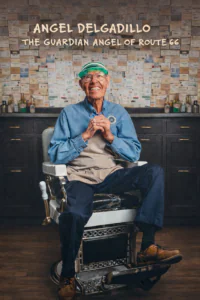
I wondered how this humble barber, who ran his own shop since 1950, rose to leadership in transforming not only his town and business, but also the once-bustling Arizona and California towns that were withering along the route. Here’s what I learned:
- Angel listened to his customers. The people in his chair consistently lamented about how life without Route 66 was unbearable.
- Angel conducted market research with his patrons and developed a vision for creating an engaging experience for travelers that would inspire increased traffic and income so desperately needed. He shared his plan with everyone he came in contact with. In founding the Historic Route 66 Association, he inspired his fellow Seligman citizens to adopt the cause, as well as potential leaders in other cities in all eight states along the route to embark on revitalization. Leaders need teams and believers to execute their vision.
- Angel accepted that change had made it necessary to move forward with new ideas and new actions that would help his town remain vital. He embraced agility.
- Angel had a spirit of grit, ingenuity, agility, innovation, and determination.
- Angel led like he meant it and is thriving today at 99.
Global Influence
This leader’s modest background didn’t limit his notoriety, as he became something of a global legend. Movie director John Lasseter met with Angel while researching the history of Route 66 for the 2006 Pixar motion picture “Cars”. His passionate description of how traffic through Seligman virtually disappeared on the day that nearby Interstate 40 opened is depicted in the film through a 3½-minute flashback in which the town and highway literally vanish from the map. Sally Carrera (an animated gynomorphic Porsche 996) is the vehicle that delivers the message.
Beyond being the subject of an interactive AI exhibit in a museum in another nearby town, over the years, tourists from all over the world traveling the road have made Angel an attraction, stopping to meet and talk with him. When the Associated Press interviewed him, he met with tourists from Europe and Asia.
Far from the Maddening Crowd
Now that I’ve rejoined the frenetic pace of today’s business, I find myself reflecting on what I would describe as adventurous—not thrilling, not glamorous, but a refreshing departure from the usual. An apt analogy is the disparity between I-40 and the old highway that was visible along much of the route. We could see the constantly congested interstate while we sailed along the wide-open 66. Plus, I was not the least bit envious of those I-40 travelers who had Internet access while we did not. I actually LOVED being unavailable until we got to our next motel. Our only worry was what to do in case of car trouble. 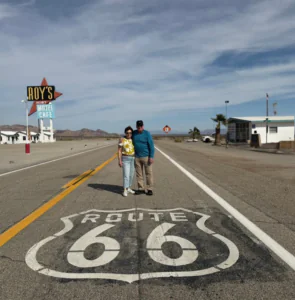
For those of you who now have a case of FOMO, I say, “Go for it!” Enjoy the entire experience, if only for a couple of days. Give your heart-healthy diet a break with homecooked diner meals. Let the neon signs dazzle your screen-weary eyes. And inhale the romance of the rails with museums dedicated to the railway on which the towns along Route 66 were established.
I’ll close with one more incentive. Each person we spoke with in each town made us feel like we really mattered. Everyone wanted to know about us. Their constant smiles reflected how dedicated they were to their town’s success. And isn’t that the goal of every experience we create for clients, employees, partners, etc.?
We’re here to help you bring these lessons to life to make those who matter most to your business feel like they matter. Call 800-742-6800 or email us today. For more insights, sign up for our monthly newsletter at askhillarys.com (bottom right corner of the page).
Follow us on LinkedIn. If you find this article valuable, please share it with a colleague or two or three.