
The Nature of Generative AI
GPT (Generative Pre-trained Transformer) pulls information together, translating words into unique numbers based on the context of surrounding words. Maximizing the information that Generative AI delivers for accuracy and relevance, therefore requires prompts rich in context.
That makes prompting a critical requirement, which is why Sam believes the 95% of companies that reported their AI investment produced “workslop” created insufficient prompts.
Fool-Proof Prompting: Try it Out
YouGotPrompts.com is a site used by thousands of users, where prompts of all kinds that have been created by others (look for those with 4-plus-star ratings) are available, or you can create custom instructions using any GPT.
After landing in Oz and taking in its wondrous sites, Dorothy emits those immortal words.
And after completing the impossible tasks assigned by the great and mighty Oz, Dorothy and her trio of companions return to claim their prizes. Who can forget Toto pulling back the curtain to reveal the powerful wizard is a mere mortal who’s operating a cache of audio/visual machinations?
Sam Richter CSP, CPAE, was a brilliant stand-in for Toto at the April 21 Business Leaders Breakfast Forum, demystifying the power of AI. However, unlike that wizard’s deceptive chicanery, Sam’s presentation confirmed the practical power of Generative AI and why it simply isn’t an option for business survival. “Adopt AI or die,” he claimed. And he backed his proclamation with practical AI tools, resources, and processes to create greater productivity and measurable outcomes, resulting in invaluable lessons about how to unleash AI not only as a competitive advantage, but also as a way we can improve our personal lives and connections.
Sam’s insights couldn’t have come at a more opportune time, with most people wary, if not pessimistic, about AI and what it will do for them—understandably so considering early applications focused on entertainment snippets and betting. There’s been more publicity about deep fakes and AI-driven lay-offs than real-world economic outcomes. 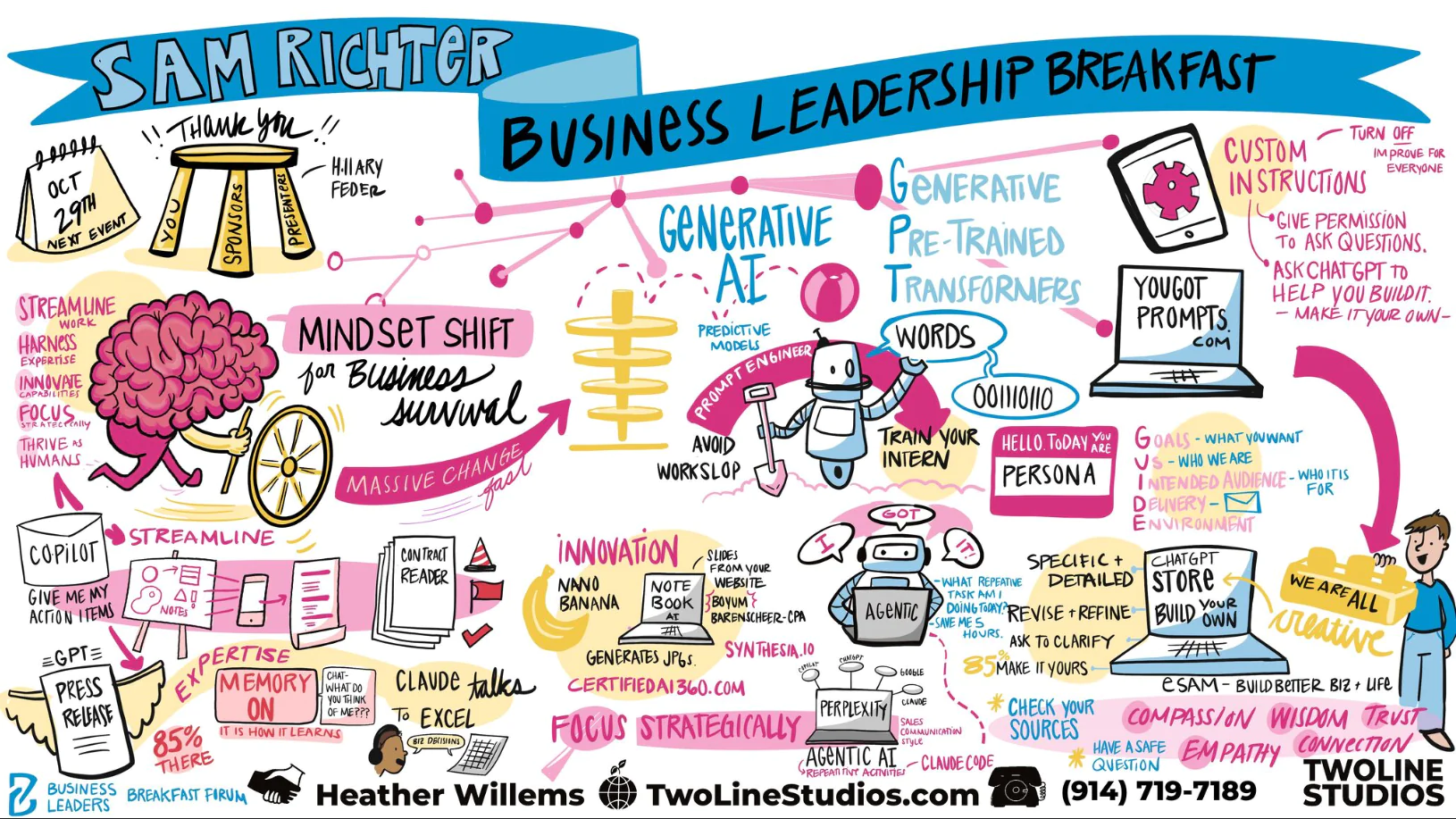
Reframing AI with a Mindset SHIFT 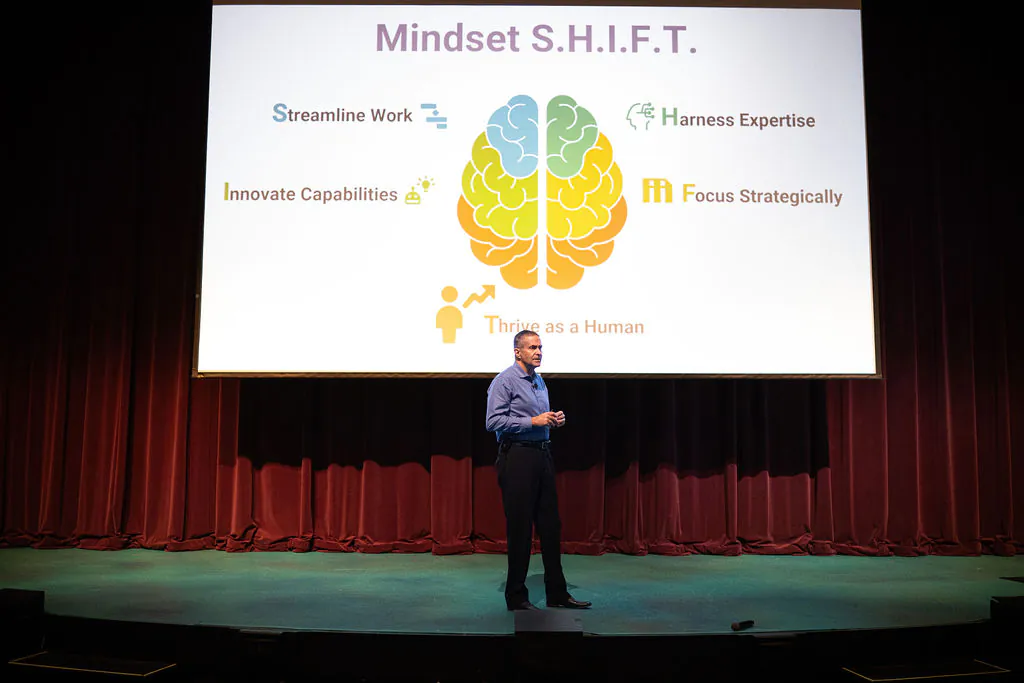
Sam shared his framework for viewing Generative AI through Mindset SHIFT as a tool to:
- Streamline work—merge Outlook with CoPilot to prioritize responses; search for prospects and contact information; upload data with prompts to analyze, display, recap, and perform actions.
- Harness expertise—use your knowledge and upload documents and other data to create high-level prompts that deliver optimum results for decisionmaking; example—ideal warehouse location (longitude/latitude) within a geographic area.
- Innovate capabilities—create something that was previously time-consuming or impossible, such as PowerPoints, videos, infographics, logos, packaging (tool references: notebooklm.google.com, synthesia.io/heygen.com, gemini.google)
- Focus strategically—leverage Generative AI’s deep research capability to eliminate the strategic advantages held by larger companies with big budgets and high-priced expertise; gather intel about prospects (how they buy), customers (and their customers), and competitors to create differentiating positioning, automated engagement processes, SWOT analyses, and more; set news alerts about prospects and customers that integrate with your CRM program to automate customer engagement; automate proposal creation.
- Thrive as a human—redirect saved time toward connecting and communicating with others inside and outside of work.
Acknowledging that hype, fear, and uncertainty can make AI an overwhelming proposition, Sam advised getting started with assessing its place in your organization by examining:
- repetitive tasks that can be optimized
- creativity that can be used to differentiate
- strategic initiatives that can be accelerated
The goal of AI is to free up time to spend on what matters—providing value and being human, such as connecting and communicating.
How to Prompt for AI Success
Emphasizing that prompt engineering is the key to generating successful AI results, Sam urged us when creating prompts to treat AI (Claude, Perplexity, ChatGPT, Gemini, CoPilot) like super-smart human interns no experience. He shared examples of what he referred to as A-, D-, and F-level prompts, focusing on A-level prompting that requires somewhere between 200-600 words. Some of Sam’s thoughts about being as specific and detailed as possible:
- You are a at [company/description/industry]. Include the company’s mission, values, and differentiation/positioning.
- You’re responsible for .
- You need to create a [work product] for [intended audience description] that does [desired goal]. Include details such as tone, length, neutral or opinion, creative or facts.
- Describe expected results–how they will be delivered (bulleted list, narrative, subheads, etc.), and who they will be delivered to, and the environment they will be delivered in (various meetings, newsletter, etc.)
- Be as specific and detailed as possible and continually refine; Cite sources and double-check them.
- They even threatened to fire it or use a competitor.
- Tell it to ask for clarification.
- Make it yours…your words.
- Encourage GPT to ask questions if it needs clarification.
Beyond initial prompts, Sam advised refining results by asking AI to cite sources and double-check statements. He even suggested threatening to fire it and use a competitive GPT if unsatisfied with the results. However, be polite and thank your AI partner as you would a colleague.
Cultural Consequences
As we marvel at Generative AI’s prowess at propelling efficiency and its bourgeoning capabilities, it’s important to keep in mind its limits. What do we have that AI does not?
 Now aren’t these qualities what make strong, successful leaders who are capable of shepherding thriving businesses? To me, it looks like we need AI as much as AI needs us to prove its value. Call it a match made in cybersphere.
AI can distribute information, but it can’t foster a sense of belonging. It doesn’t know how to recognize someone for a job well done. It can’t tell its supervisor, “No worries, I’ve got this.” In other words, it can’t create engagement that drives a positive company culture. It won’t build trust with a skeptical workforce or know when it’s best to say nothing. Heck, we know it may intentionally lie. The truth is, AI has yet to prove that it lacks discretion and integrity.
Employee FOBO (fear of becoming obsolete) and feeling devalued due to “AI washing” and slumping hiring statistics are driving alarming statistics. According to Sam, 29% of employees report sabotaging their company’s AI initiatives out of fear, and 44% of GenZ employees are sabotaging in-house AI deployments. Leaders need to explain to employees how AI will impact their jobs and offer the skills they will need to use AI. (more about dealing with cultural impact here. This link goes to our March article
Discussions with employees also need to include parameters around AI use, such as:
- how to keep data safe;
- how to maintain integrity of results by double- and/or triple-checking;
- how to eliminate misinformation/disinformation; and
- how to use a secret word to protect against scams/system hacks.
Concluding Counsel
My advice for leaders is to approach AI adoption as a cultural opportunity to help normalize the change. We’re here to help you transition your organization’s culture through AI adoption, ensuring that the people who matter most to your business continue to feel like they matter. Call 800-742-6800 or email us today. For more information and tips, sign up for our monthly newsletter at askhillarys.com (bottom right corner of the page).
Follow us on LinkedIn. If you find this article valuable, please share it with a colleague or two or three.